

Latest Weather Blog
Set your alarms for Tuesday's 'Blood Moon' as a lunar eclipse takes over the sky
It’s about time to look up again; a night sky wonder will soon be visible in the Capital Area. In the early hours of Tuesday, March 3, 2026, a total lunar eclipse will sweep across the sky, turning the moon a dusty red in what is famously known as a “Blood Moon.”
A lunar eclipse occurs when the Sun, Earth, and Moon align perfectly, casting the Moon into Earth’s shadow. During a total eclipse, the Moon moves into the umbra, the darkest part of Earth’s shadow. However, it doesn't go pitch black. Instead, sunlight filters through the edges of Earth’s atmosphere and reaches the Moon to give off the iconic crimson glow. Essentially, the light of every sunrise and sunset on Earth gets projected onto the lunar surface.
Tuesday will also feature a rare selenelion, a unique eclipse where the Sun and eclipsed Moon are visible at the same time. This sight is only possible near moonrise or moonset. In this instance, the selenelion will occur after totality. The partially eclipsed moon will set at 6:31 a.m., while sunrise will occur at 6:29 a.m., leaving a brief window to catch both at once. Success for observers will depend on having a perfectly clear, unobstructed view of both the eastern and western horizons.
Viewing the eclipse in Baton Rouge, Louisiana
In Baton Rouge, the eclipse will begin in the predawn hours on March 3. The Moon will only glow red during totality between 5 and 6 a.m. It will be sitting quite low on the horizon, so for the best view, look toward the western sky closer to 5 a.m., well before moonset and sunrise.
Trending News
• Penumbral eclipse begins: 2:44 a.m. CST*
• Partial eclipse begins: 3:50 a.m. CST
• Totality begins: 5:03 a.m. CST
• Totality ends: 6:02 a.m. CST
• Moon sets below horizon: 6:31 a.m. CST
*The penumbra is the faint outer shadow of Earth. The Moon dims only by a slight amount as it enters the penumbra. This would be difficult to spot with the naked eye. The real “show” begins once the partial phase starts
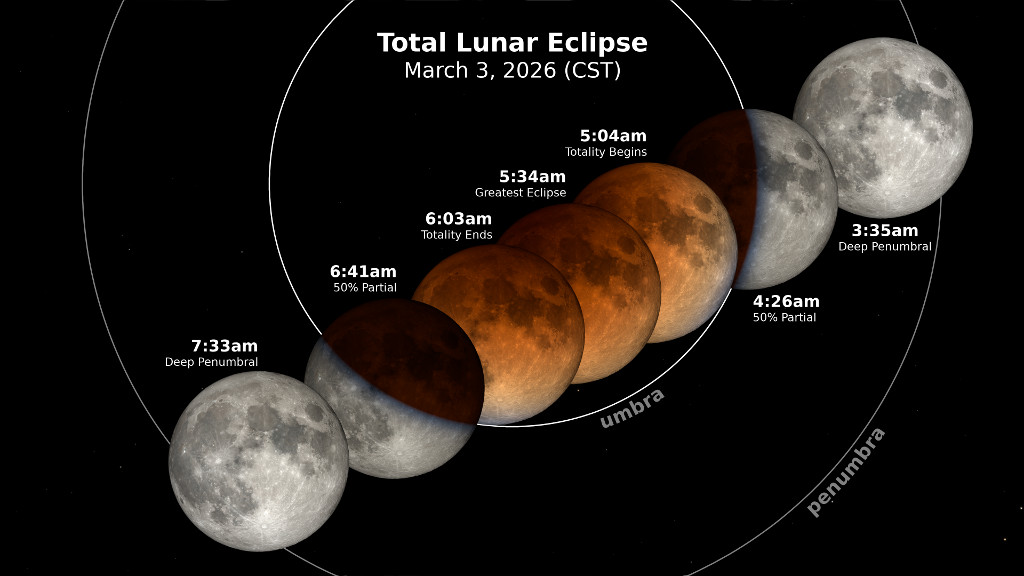
Courtesy: NASA
As the Moon dims during an eclipse, surrounding stars will appear brighter than usual, offering a great opportunity for stargazing. No special equipment is needed to observe this event, but binoculars or a telescope can enhance the experience. Of course, clear skies will be needed for optimal viewing, so stick with the Storm Station for the latest forecast.
The Storm Station is here for you, on every platform. Your weather updates can be found on News 2, wbrz.com, and the WBRZ WX App on your Apple or Android device. Follow WBRZ Weather on Facebook and X for even more weather updates while you are on the go.
More News

